Where Can I Find The Math Map Scope and Sequence?
Inside TMM Complex Booklet and also inside TMM Companion, the "i1" page serves as our scope and sequence page. The left-hand side shows the 30 booklet titles which are the same in each domain. At the top, there is a colorful diagram with letters and words that describe numbers and other math ideas. These are called the domains. You may be used to thinking of math curricula according to grade levels. Because The Math Map focuses on the whole family, it uses domains. In each domain, students begin calculating with the numbers in that domain while continuing to practice with numbers in narrower domains.
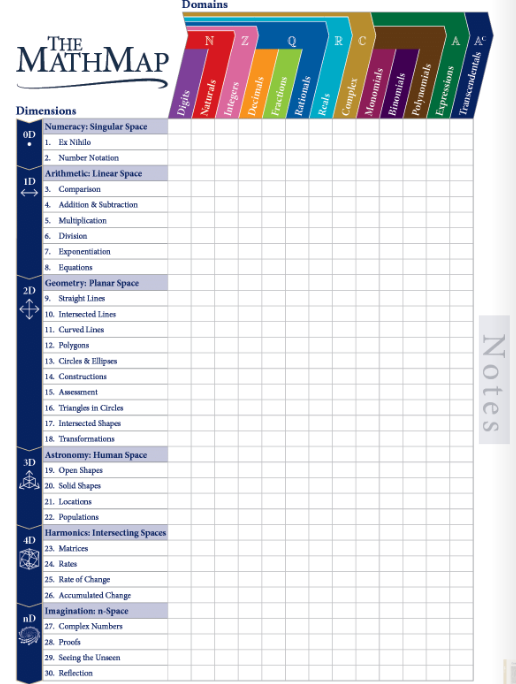
For example, in the Complex domain, students practice calculating with all forms of complex numbers. If you need more about each domain, you can access TMM Companion and click on each domain at the top.

In this example, we clicked on the Rationals bar on the left to see the description on the right. As you can see, the focus at the Rationals level is practice with fractions, decimals, and percent with very large positive and negative numbers.
To see how a single concept (Converting between fractions and decimals) is developed across the domains, let’s look at what a typical 6-year-old would encounter in Naturals on page 16 in the Comparison (Lesson 3) booklet:

So at 6, the student is tracing and coloring, and is introduced to the idea that 1/3 = 0.333… = a circle divided into 3 equal pieces with one piece shaded. Here’s the same exercise in Fractions, which has a typical 9-year-old in mind:

Now the student is exposed to more fractions with repeating decimals, and is being asked to match the different notations. I notice that the fractions that may be less familiar to this student are used as examples, which lets the student practice the skill of Comparison as he or she completes the exercise. In the Complex domain booklet, we see this exercise for 12-year-old students:

A typical 12-year-old student may be familiar with some of the fraction/repeating decimal pairs, be able to add, subtract, multiply, and divide decimal numbers, and have had some practice performing these operations vertically. In this exercise, the student is expected to Compare the example on the left to the practice exercises on the right and notice the patterns. The calculations are probably familiar; the arrangement of the calculations into an algebraic procedure may be unfamiliar.
Each domain level covers the same concepts (such as converting between fractions and decimals) using age-appropriate activities and building on previous knowledge.
